As we make our way through the first week of carb cycling, you may have become more aware of labels and have started to be more intentional about learning what is in the products that you buy. But what about the foods that don't have labels? Here's a list that will help you out. Notice I didn't list how many carbs each food has - this is because I want you to remember we AREN'T counting carbs. We are just targeting lower/higher carbs on different days. So if I listed something as "lower carb" then trust me :).
Vegetables:
Swiss Chard
Mushrooms
Celery
Cauliflower
Zucchini
Spaghetti Squash
Radish
Asparagus
Bok choy
Broccoli
Kale
Spinach
Arugula
Bell peppers
Edamame (also a protein)
Watercress
Cherry Tomatoes (also classified as a fruit)
Carrots (some classify as lower carb, some classify on the low end of higher carb)
Fruits:
Apricots
Avocadoes (also a fat)
Red Grapefruit
Rhubarb
Watermelon
Peaches
Star fruit
Cantaloupe
Blackberries
Strawberries
Dairy:
Gruyere Cheese
Butter
Eggs
Almont & Coconut Milk
Cottage Cheese
Plain Greek Yogurt
Goat Milk
Brie cheese
Goat cheese
Monterey cheese
Ricotta
Plain kefir
Sour cream
String Cheese
Other:
Pumpkin Seeds
Jerky
Walnuts
Almonds
Kale Chips
Pecans, hazelnuts
Another thing to remember...if you are out and about and really need a snack, it's okay to have a protein bar such as a Quest bar. At first glance it seems like they are high in carbs (25 grams). But they also have 17 grams of dietary fiber, so the net carbs are actually 8g (# of carbs less the amount of fiber). Because there are no sugar alcohols in most of them, the all-natural Quest bar flavors like Chocolate Peanut Butter, Chocolate Chunk or Cinnamon Roll are good choices if you need an on-the-go snack. Just some "food for thought"...chuckle!
Friday, December 4, 2015


Wednesday, December 2, 2015
Low-Carb Snacks!
Needing some easy ideas for snacks on your low-carb days? Here are a few suggestions:
Make your own Trail Mix:
1 cup roasted peanuts
1 cup raw or roasted almonds
1 cup pumpkin or squash seeds (you can purchase these already toasted)
2 oz unsweetened coconut
½ cup raisins or currants (loosely-packed, i.e. don’t cram in as many as possible)
3T 100% cacao chocolate chips
- Celery with natural peanut butter or almond butter
- Celery with tuna salad
- Hard boiled eggs
- 1/4 cup berries with 1/3 cup cottage cheese
- Nuts (keep raw ones in the freezer if you think you'll overeat them)
- Sunflower seeds (get them in the shell so it will take longer to eat them)
- Low-Carb Trail Mix (see below for recipe)
- Jerky (beef or turkey -- try to find low-sugar varieties)
- Low-carb shakes
- Cheese sticks, such as string cheese
- Cheese with apple slices
- 4-ounce plain Greek Yogurt with Truvia sweetwner or with berries and flax seed meal
- Smoked salmon and cream cheese on cucumber slices
- Lettuce Roll-ups -- Roll luncheon meat, egg salad, tuna or other filling and veggies in lettuce leaves
- Lunch Meat Roll-ups -- Roll cheese or veggies in lunch meat (read the labels for carbs and sodium on the lunch meat)
- Spread bean dip, spinach dip, or other low-carb dip or spread on the lunch meat or lettuce and then roll it up
- Raw veggies dipped in mashed avocado and/or salsa
- Low-carb snack bars (with no sugar alcohols, especially maltitol)
- Ricotta cheese with raspberries
Make your own Trail Mix:
1 cup roasted peanuts
1 cup raw or roasted almonds
1 cup pumpkin or squash seeds (you can purchase these already toasted)
2 oz unsweetened coconut
½ cup raisins or currants (loosely-packed, i.e. don’t cram in as many as possible)
3T 100% cacao chocolate chips
Tuesday, December 1, 2015
Food List Suggestions!
I thought it might be helpful if I posted a list of foods that you can choose from for your low and high carb days. I know a lot of you have also done some research on your own, so keep posting what has been helpful to you! At the same time, don't hesitate to ask questions and seek support from this group!
Much of this list I took from a post from Chris Powell's book, Choose More, Lose More for Life. I added some of my thoughts and ideas based on my personal research and study, as well as some personal comments about my eating habits.
Much of this list I took from a post from Chris Powell's book, Choose More, Lose More for Life. I added some of my thoughts and ideas based on my personal research and study, as well as some personal comments about my eating habits.
General guidelines:
- When to eat
- Eat breakfast within 30 minutes of getting up *Jen: Since I workout first thing in the morning, my breakfast is later than 30 minutes after getting up. If your schedule does not allow for this, don't sweat it! Just eat when you can and strive for it to be fairly early in the day.
- Eat another meal or snack every 3 hours for a total of 5 meals/snacks in the day
- Example carb-cycling meal schedule, with a 6.45 am wake-up time: 7 am breakfast, 10 am morning snack, 1 pm lunch, 4 pm afternoon snack, 7 pm dinner; eat similar amounts for each meal or snack *Jen: I typically eat more for my meals than for my snacks. That is certainly fine!
What to Eat:
- Protein – lean and low-sodium
- Beef – cube steak, flank steak (lean), roast beef (low-sodium), round steak, sirloin steak (extra lean), ground beef (extra lean)
- Game meats – venison, elk
- Pork – tenderloin, low-sodium ham
- Poultry – chicken breast (skinless), chicken thighs (skinless), ground chicken breast, duck breast, turkey breast (low-sodium deli), turkey breast (skinless, not deli), ground turkey (99% fat-free)
- Fish – branzino, catfish, cod, flounder, grouper, haddock, halibut, pollock, salmon, sardines, sea bass, snapper, sole, swordfish, tilapia, tilefish, trout, tuna
- Shellfish – clams, lobster, shrimp
- Dairy – cottage cheese, egg substitutes, egg whites, Greek yogurt (nonfat, plain) *Jen: Don't freak out here about egg whites...egg yolks are listed under fats. Eat the whole egg!
- Powdered protein – whey protein, egg protein, soy protein, rice protein, hemp protein
- Vegetable protein – tempeh, textured vegetable protein, tofu. For vegetarians, tofu can be substituted into any meal
- Fats
- Dairy – cheeses – blue cheese, brie, cream cheese, egg yolk, feta cheese, goat cheese, mozzarella, parmesan, romano, sliced cheeses (e.g. cheddar, colby, gouda, havarti, monterey jack, muenster, swiss)
- Dairy – other – cream, sour cream
- Dressings – creamy dressing, mayonnaise; make your own if you can
- Fruit – avocado, olives
- Nuts and seeds – almonds, almond butter, peanut butter, pecans, sesame seeds, sesame butter, sunflower seeds, walnuts
- Oils – flaxseed oil, olive oil, coconut oil
- Vegetables
- Unstarchy vegetables – artichokes, asparagus, bell peppers, bok choy, broccoli, broccoli rabe, brussels sprouts, cabbage, cauliflower, celery, chard, collard greens, cucumber, endive, eggplant, fennel, garlic, green beans/wax beans, kale, leeks, mushrooms, mustard greens, okra, onions, peppers, parsley, radicchio, radishes, rhubarb, salad greens (arugula, romaine, other lettuces), scallions/green onions, shallots, snow peas, spinach, sprouts, squash, tomatoes, turnips, zucchini, spaghetti squash
- Root vegetables and starchy vegetables, listed under carbs below
- Flavorings
- Herbs – including basil, parsley, rosemary, thyme
- Spices – including cajun seasoning, cayenne pepper, cumin, fennel seeds, garlic powder, ginger, Italian seasoning, paprika, steak seasoning
- Butter/olive oil spray, chili paste, chili sauce, extracts (e.g. almond extract, peppermint extract, vanilla extract), hummus, horseradish sauce, hot sauce (e.g. Tabasco), ketchup (Simply Heinz or other brand with NO added sugar), lemon juice, lime juice, low-sodium broth, low-sodium soy sauce, marinara sauce, mustard, salsa, tomato paste, tomato sauce, vinegar (e.g. cider, red-wine, white-wine), Worcestershire sauce (watch out for high sodium)
- Salad dressings – consider the fat content – balsamic vinaigrette, French dressing, Italian dressing; make your own!
- olive oil, coconut oil
- Sweeteners – stevia (e.g. SweetLeaf, Truvia), xylitol (e.g. Xlear, Xylosweet), sorbitol, erythritol, honey in very small amounts
- Beverages
- Almond milk (unsweetened), soy milk (unsweetened)
- Coconut water (pure)
- Coffee, tea (regular, green, or herbal)
- Tomato juice
- Water (flat or sparkling)
- Protein Shakes as detailed below *Jen: As you know, my recommendation is Shakeology so that you get a balanced amount of nutrients, protein and carbs.
Foods that may be eaten for breakfast on low-carb days, and in all meals on high-carb days:
- Fruits
- Apples, apricots, bananas, berries (blackberries, blueberries, cherries, raspberries, strawberries), grapes, grapefruit, kiwifruit, lemons, limes, oranges, mangos, melons, nectarines, papayas, peaches, pears, pineapple, plums, tangerines
- Carbs
- Breads – brown rice tortillas, corn tortillas, Ezekiel 4.9 breads, Ezekiel 4.9 English muffin, Ezekiel 4.9 tortillas, whole-grain bread
- Cereal – All-Bran, Fiber One, Kashi Go Lean, Kashi Good Friends Cereal, Kashi Heart to Heart, low-fat granola, old-fashioned oatmeal, steel-cut oatmeal
- Grains – amaranth, barley, bran, buckwheat, brown rice, millet, oats, popcorn, quinoa, wild rice
- Legumes – beans (boiled or low-sodium canned), lentils, soybeans/edamame, soy nuts (slightly salted)
- Pasta – brown rice pasta, couscous, whole grain pasta
- Root vegetables – beets, carrots, parsnips, potatoes, rutabagas, sweet potatoes/yams, winter squashes (butternut, acorn)
- Starchy vegetables – corn, peas
- Meal replacement shakes
- Contain protein, carbs, fiber, vitamins, and minerals (avoid carb-containing shakes for no-carb meals)
Foods to Avoid
These may be eaten in your reward meals or reward days, if you have to, but keep them out of your house to avoid temptation.
- Processed and refined carbohydrates
- Table sugar and other sugars, including brown sugar, corn syrup, raw sugar
- Candy, chocolate, ice cream, soda with sugar
- Fruit juice
- Refined flour / white flour and foods containing it
- Baked goods such as bagels, white bread, cake, cookies, crackers, pretzels, donuts, pastries
- White rice
- Chips *Jen: On my reward day I certainly enjoy Sun Chips and salsa. BUT! I don't go crazy and eat out of the bag. A good rule of thumb is SERVE foods onto your plate, not keep reaching into the bag or box.
- Processed foods
- If you have to get processed foods, try to find low-sodium options
- Fatty foods
- Fried foods
- Hydrogenated oils
- Foods high in sodium
- Alcoholic beverages
- Beer, wine, hard liquor *Jen: I have nothing against a good bottle of wine! Just enjoy in moderation is the message here.
- Artificial sweeteners
- Saccharin (Sweet’N Low), sucralose (Splenda), aspartame (Equal, NutraSweet)
- These can be useful while you’re cutting back on sugary processed foods and getting used to eating whole, healthy food
- It is a very good idea to eventually switch from all artificial sweeteners to natural sweeteners
Monday, November 30, 2015
Carb Cycling: A Food Schedule!
So you've chosen your plan and you are ready to jump in but you likely have a few questions about "how many carbs" or "how much protein". First off, the reason I really like this concept is that we are not going to "count" anything. The loose recommendation for calories are between 1200-1400 on low carb days and 1400-1700 on high carb days. If you workout 6 days a week, you need the higher calorie counts. If you workout less, or with less intensity, you can roughly follow the lower end. You can count calories and grams, but I really don't have time for that and I am guessing that you don't either!
Basically, it’s time to rethink how you think about carbs!
First, the basics: carbs—and the roles they play in your diet—are actually pretty simple. If it comes from a plant, it’s a carb, and carbs are the preferred fuel source for your muscles and organs. Breads, beans, potatoes, table sugar, fruits, and vegetables are all carbs.
There are two categories of carbs: simple and complex. The simple, not-so-healthy ones are found in foods such as cakes, cookies, some commercially made breads, and many processed foods (that table sugar - boo!). Your body breaks down simple, not-so-healthy carbs very quickly, which spikes your blood sugar levels and stimulates the release of insulin, resulting in a craving for more simple carbs. And that is soooo not good!
Now fruits are also considered simple carbs because of the type of sugar they contain, but they’re a healthy choice because they’re loaded with vitamins, minerals, electrolytes, antioxidants, and some fiber.
Complex, healthy carbs – like those found in legumes, root vegetables, whole-grains, cereals, breads and pastas – are typically high in fiber, which slows food digestion and the release of sugars. This keeps your blood sugar and energy levels steady (and longer lasting), so your calorie-burning furnace stays hot and burns more calories! And that is awesome!
So how do carbs fit into our carb cycling program? It’s actually pretty simple. No matter what carb cycle you chose, every breakfast of every day is a high-carb meal, which means you’ll eat a portion each of protein, carbs, and hopefully vegetables. Every breakfast, every day. Your carb can be a grain, a legume, a starchy or root veggie, or a fruit. If you don't have time to make a breakfast like this every day, go for a good protein shake or even better, Shakeology. If you make a protein shake, you need to add some kale or spinach. If you use Shakeology, it has everything in one scoop that you need for that meal.
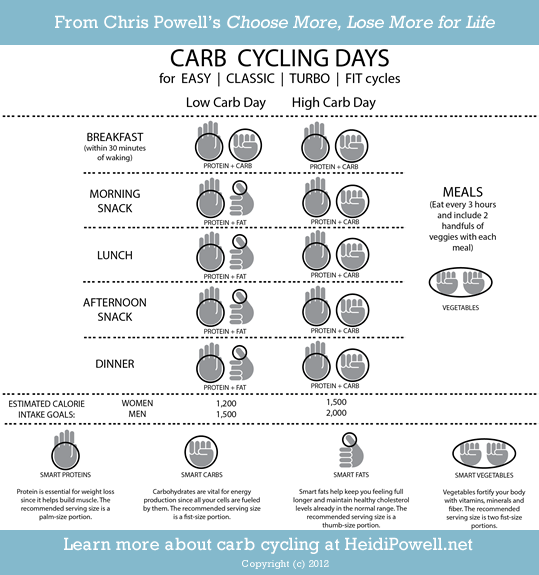
On low-carb days, your remaining four meals (spaced every three hours) consist of a portion each of protein, fat, and veggies (think fibrous green veggies, not the starchy, root kind), and on high-carb days, your remaining four meals (spaced every three hours) are made up of a portion each of protein and complex carbs (grains, legumes, starchy or root veggies, or fruits). And if you’re still hungry, you can always throw in a portion of veggies (again, the fibrous greens). Remember: with carb cycling, you can have a portion of fibrous green veggies with every single meal (starchy, root veggies, like potatoes, will fall into the carb category)! Pretty simple, right?
Here’s the most important take-away about carbs: with carbs and carb cycling, it’s not about a magic number of grams of carbs to eat every day. It’s about spreading your carb intake throughout your high-carb days—using portion sizes instead of gram counts—so your body gets the greatest benefits from those healthy carbs you eat. And wouldn’t you much rather measure portions sizes than count grams? I think yes!
I borrowed this chart from Heidi & Chris Powell's website - I really like how they lay it out in an easy form. Print this off and keep it handy for reference! And don't stress yourself with this plan. It's designed to be easy and flexible based on your weekly schedule.
For more information on Shakeology, visit www.shakeology.com/jenniemann.
I'll be posting meal and snack ideas as we go and I encourage you to do the same! Post your questions, thoughts, ideas and anything you believe will help and encourage everyone in this group.
Wednesday, November 25, 2015
Carb Cycling: The Four Cycles
Easy Cycle:
Are you ready to make changes to your nutrition but have a hard time going without your favorite foods? Then consider starting with the Easy Cycle. In this cycle you alternate low-carb and high-carb days, and on every single high-carb day you can have a reward meal, as long as that meal ISN'T your dinner meal.
Are you ready to make changes to your nutrition but have a hard time going without your favorite foods? Then consider starting with the Easy Cycle. In this cycle you alternate low-carb and high-carb days, and on every single high-carb day you can have a reward meal, as long as that meal ISN'T your dinner meal.
That’s right, you can eat the foods you love—four days a week— and still make progress toward your weight loss goals. And by favorite foods I mean pizza, ice cream, bacon, chocolate cake, cheesecake—they’re all okay. The power of this cycle is that if you get those favorite food cravings on low-carb days, you only have to wait until the next day to satisfy them. Anyone can do that! Success can be yours with this cycle.
How is this possible? First of all, you’ll be following the low-carb/high-carb eating plan for your non-reward meals, and the success of this pattern has been proven many times over. And even though you’ll be rewarding yourself, you’ll be rewarding yourself less often. Let’s say you usually eat seven desserts a week. With the Easy Cycle you’re eliminating three desserts a week, and that’s a lot of calories! You’re satisfying your cravings without depriving yourself, and losing weight.
Here’s what an Easy Cycle week looks like:
- Monday: Low-carb day
- Tuesday: High-carb day w/ reward meal
- Wednesday: Low-carb day
- Thursday: High-carb day w/ reward meal
- Friday: Low-carb day
- Saturday: High-carb day w/ reward meal
- Sunday: High-carb day w/ reward meal
For all your meals, on both low and high-carb days, you will strive to eat smaller portions than you would prior to Carb Cycling. The more calories you can cut, the faster you’ll lose that extra weight!
No, you won’t lose weight as quickly as you would in other cycles, but the important thing is that you will lose weight, and you’ll also be forming healthy habits that will last. And, as you exercise self-control in your choices on non-reward days, this practice will become easier, and you will find yourself wanting to replace those reward cravings with better choices. Then when you’re ready, you can move onto another cycle if you want to. Or you can stay with the Easy Cycle throughout your weight loss journey. It’s totally up to you!
You can also modify the Easy Cycle and have less days with a reward meal. Perhaps you start with 4 days with a reward meal and move toward 2 days with a reward meal. It also doesn't have to be a whole reward "meal"! Let's say the family wants to go out for ice cream. Make that happen on a reward meal day, and that is your reward.
Classic Cycle:
Unlike the Easy Cycle, which has a reward meal incorporated into every high-carb day, the Classic Cycle has an entire reward day every week. You target a whole day to satisfy those cravings for your favorite foods! And you’ll still lose weight.
Here’s what a Classic Cycle week looks like:
- Monday: Low-carb day
- Tuesday: High-carb day
- Wednesday: Low-carb day
- Thursday: High-carb day
- Friday: Low-carb day
- Saturday: High-carb day
- Sunday: Reward day
With the Classic Cycle, besides losing weight at a constant pace, you’ll also be able to tune into what is happening in your body during this carb cycle process. You’ll learn and actually feel how food affects your body, and while you may experience some brief periods of nausea, headaches, low energy and other symptoms as you change the way you fuel your body, these will be temporary. In the end, you’ll have a whole new appreciation for this marvelous body you have! And as with the Easy Cycle, you can stick with the Classic Cycle throughout your weight loss journey or move onto another cycle. You are in control!
You can also choose to do a combination of the Easy and Classic Cycles - have one day with a reward meal and still have the reward day. I have done this for years - if we are travelling and want to stop at Dairy Queen (which the Niemann's do quite often!), I enjoy a chocolate cone. Then every Sunday is my reward day and that's the day I enjoy chips & salsa, a bowl of ice cream, a favorite candy or a little extra bread.
Turbo Cycle: If you want to shed those extra pounds a little faster, the Turbo Cycle is for you. Of the four carb cycles, this cycle takes off weight the fastest. Unlike the Easy and Classic cycles, which alternate low and high-carb days, the Turbo Cycle pits two low-carb days against every high-carb day. That means you’ll burn fat two days in a row before your body’s furnace (metabolism) is re-stoked on your high-carb day, and you’ll lose weight faster!
Even though the Turbo Cycle has an extra low-carb day as compared to the Easy and Classic cycles, it is not a severely calorie-restricted cycle that will crash your metabolism. As with the other cycles, women should not consume fewer than 1,200 calories a day, and men should not consume fewer than 1,500 calories a day. And those numbers are low! If you are exercising regularly, women should strive for closer to 1,400 calories, and men at least 1,800. Since you’ll have two low-carb days in a row, you may feel less energetic on the second low-carb day. But this is okay. Grab some extra protein and/or fats, and let the low-carb days be your powerful weight-loss accelerators!
Here’s what a Turbo Cycle week looks like:
- Monday: Low carb day
- Tuesday: Low carb day
- Wednesday: High carb day
- Thursday: Low carb day
- Friday: Low carb day
- Saturday: High carb day
- Sunday: Reward day
As with the other cycles, you can stay with the Turbo Cycle as long as you want, or you can change cycles. Or, you can add a reward meal on one of your high carb days. This program is tailor-made to you and you alone! Don't feel like you have to stick to the exact plan as it is laid out above. If you have too many restrictions, you will be stressed about it and that's what we are working to avoid.
Fit Cycle: If you are serious about fitness and exercise 6 days a week, or if you to train for long periods of time but you want to “lean up” without compromising your athletic performance, you might consider the Fit Cycle. The Fit Cycle not only eliminates fat, but it also supplies your body with the fuel it needs to perform successfully, no matter what sport you choose to excel in.
Unlike the other three carb cycles, the Fit Cycle only has two low-carb days per week, and there’s a very important reason for this: The extra high-carb day allows your muscles to absorb more fuel (glycogen), which you’ll need for maximum athletic performance. During your low-carb days, when this supply of glycogen gets depleted, your muscles will develop insulin sensitivity. When you then have a high-carb day or your reward day, these insulin-sensitive muscles will actually soak up more carbs, your body will burn this extra fuel instead of storing it as fat, and you’ll still lose weight. It’s an amazing process!
Here’s what a Fit Cycle week looks like:
- Monday: High-carb day
- Tuesday: High-carb day
- Wednesday: Low-carb day
- Thursday: High-carb day
- Friday: High-carb day
- Saturday: Low-carb day
- Sunday: Reward Day
With the Fit Cycle, you won’t lose weight as fast as with the Turbo Cycle, but you will be able to maintain your athletic performance. However, if you do experience a slight decrease in your athletic performance with this cycle, and you’re not as concerned about losing weight, try combining the Fit Cycle with pre- and post-workout supplements or meal replacement shakes with some extra macronutrients.
And as with the other cycles, you can stay on the Fit Cycle or change cycles at any time. It all depends on your weight loss and athletic goals.
Carb Cycling - A nutrition plan for December!
Carb Cycling is a nutrition strategy that I have "sort of" used over the past few years, but just recently I did some specific research & reading about it. I discovered that it really is a great plan for anyone, allowing for flexibility in food choices, nutrients and recipes.
What is Carb Cycling?
Carb cycling is an eating plan with alternating high-carb and low-carb days. It’s that simple. It also has built-in reward days or reward meals (depending on the plan you’re following), so you can still eat your favorite foods on a regular basis. Sounds pretty much perfect, right? You can eat healthy foods, enjoy foods you love, and still lose weight.
Each plan has a different mix of high-carb and low-carb days, but the concept each day is basically the same:
- Eat at least 5 times a day, with one last optional snack, depending on your goals.
- Each day eat a high-carb breakfast that includes both protein and carbs.
- Eat your remaining meals—either high-carb or low-carb, depending on the plan you’re following—every 2-3 hours.
- Choose approved foods.
- Drink 80oz. of water.
How does it work?
In order to lose weight, our bodies need the right combination of proteins, carbs, and healthy fats. Many people leave out the fats, thinking they are "bad". Well, there are some fats that do not make the "approved" list on a regular basis! But good fats are SO ESSENTIAL to your overall nutrition.
Here’s why:
- Protein builds and maintains muscles and these muscles burn calories like an inferno. Protein also breaks down more slowly than carbs and fat, which burns even more calories and helps you feel fuller longer.
- Carbs are the preferred fuel source for your muscles and organs, and they come in healthy versions (vegetables, fruits, grains, and legumes), and not-so-healthy versions (cakes, cookies, soda, doughnuts, candy, and many processed foods). Healthy carbs are also crucial for burning calories, and since they break down more slowly than those not-so-healthy carbs, they keep your blood sugar and energy levels steady, and they also keep your calorie-burning furnace hot so it burns more calories!
- Healthy fats (unsaturated fats) eaten in moderation help the development and function of your eyes and brain and help prevent heart disease, stroke, depression, and arthritis. Healthy fats like avocadoes, coconut, grapeseed & olive oils, nuts and seeds also help keep your energy levels steady and keep you from feeling hungry.
So why do we alternate high-carb and low-carb days in carb cycling? On high-carb days you’re stocking your calorie-burning furnace so that on low-carb days your furnace burns fat, and lots of it! This pattern tricks your metabolism into burning a lot of calories, even on those low-carb days. It’s an amazing and well-proven process.
What are the benefits?
Carb cycling has many benefits:
- It fits any lifestyle.
- You’ll learn how to shed weight and body fat, and how to make smart lifestyle choices for the rest of your life. This puts YOU in control.
- You’ll feel better and have more energy.
- You’ll eat the foods you love.
- You’ll build lean, strong muscles.
- You’ll be empowered physically, mentally, emotionally, and spiritually.
Monday, November 9, 2015
Some more Whole30 recipes to choose from this week!
A couple of these are re-posts from last week but I wanted to plug them in again and give you some tips on them! I made the Balsamic roasted sweet potatoes and Brussels sprouts and it was THE BOMB! We had guests the night I made it, and everyone love it - even the Brussels sprouts!! Don't let the "balsamic reduction" scare you - you just pour your balsamic vinegar in a saucepan and let it simmer until is it reduced by about half. That's it! It make the vinegar a lot thicker and gooey-er.


This Chicken Hash dish would also be good for breakfast. You could make it for supper and make extra to have leftover the next morning.


I also made the Roasted Beet salad. Roasting Beets sounded a lot harder than it was - super simple! Cut off the tops, put them in a foil pack and roast for 45 min-1 hour. The specific directions are in the recipe below. I made this salad and served it over a mixture of spinach and romaine lettuce. The dressing was super simple and awesome.

Some Whole30 Websites to check out!

Subscribe to:
Posts (Atom)